It’s rare that a week passes without some mention of the latest discovery related to genes and DNA; credited as being the blueprint of life, there’s an oft-forgotten component to that analogy though, it takes a lot to go from blueprint to building, and the same is true on a cellular scale.
DNA is hidden away from the rest of a cell, isolated within the nucleus from the molecular building sites known as the endoplasmic reticulum. It’s the related molecule, RNA that carries the genetic instructions to those building sites.
We share somewhere between 93 and 98% of our genetic blueprint with chimpanzees, and 50% of our instructions are the same as those found within the banana – to a great extent it’s how, where and when those instructions are acted upon that accounts for our physical differences.
One such route for the “expression” of our blueprint to be modified could be by intercepting and adding tags to the instructions on their way to the building sites, and it seems that our cells may be doing exactly that – adding a tag composed of carbon and hydrogen known as a methyl-group, like the asterisk that plagues legal documents, but with the small print currently a mystery.
Of course, given the ability of these tags to influence where or when the instructions are read, it starts to make sense how they could impact diseases such as Alzheimer’s or obesity – even if the instructions themselves are still correct. Try putting doors on a building you’re yet to set the foundations for, or wallpaper across your doorways and you’re going to have a problem. That might be a tidy analogy – but the truth is that no one quite knows what these tags do. This potentially massive new layer of genetic control is almost entirely new science – and that’s exhilarating.
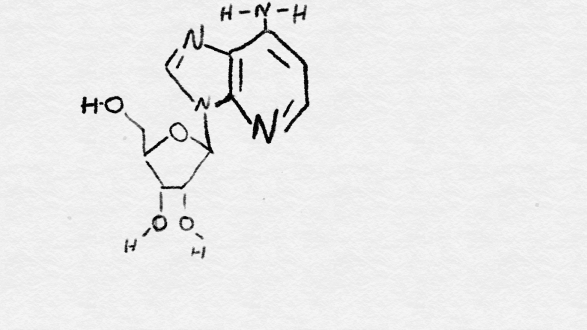
Excitingly more evidence is emerging from the laboratorial trenches showing this level of control over our blueprints is heavily exploited by our bodies. These tags have been known of for nearly four decades, they can be seen when RNA extracted from an organism is combined with a radioactive isotope. Using a chromatography method the individual molecular letters of RNA, A G C and U can be seen, along with any tags attached to them working in much the same way as some inks separate out into their constituent pigments when you let water soak through them on paper. Research into these tags has accelerated in recent years due to a greater understanding and newly developed methods, allowing for a more accurate copy of nature in the synthetic production of RNA to be tested against various proteins, or for their interaction within living cells.
Slowly, but surely, we are translating the molecular small print plastered throughout our genetic instructions.
This has led to the discovery of several important proteins responsible for the addition or removal of the molecular tags. Such discoveries include a gene heavily associated with obesity, FTO, which has recently been found to act as a so called de-methylase – removing the tags from the instructions en-route to the cellular building sites. This is big news, it adds support to the idea that a change in one gene can affect how and when other genes are used by the cell. Beyond genes turning off or on like some of the traditional models and text books like to believe, it seems that genes can be “on”, and yet exist in a cellular purgatory until the proteins they code for are needed by the cell.
Of course that is a single protein, there are others that appear to have a similar function to FTO and there are numerous proteins that interact with the instructions as they travel through the cell before they are read and built, translated, into the proteins which make up our molecular structure and machinery. These RNA-interacting proteins can redirect messages, hold them aside, or ensure that their contents are destroyed or reused. Messages can be chopped and changed after they’ve been copied from the blueprints – it is easy to imagine molecular tags on the RNA influencing some of these processes.
This is the frustrating and exhilarating nature of so called blue sky science, it appears we can chip away at nature’s intricacies to uncover enticing hints of important stories not just for the sake of science but even infringing on some big medical targets – obesity, Alzheimer’s and cancer. However, with any commercial, medical or industrial application still a spec on the horizon it can be difficult persuading the research councils to fund such topics to the extent that would allow them to flourish. If we continue to deny our researchers the freedom to follow new and exciting science down the rabbit hole, that intellectual crime may just rob us of the next big discovery.
 Capped and tailed